DV vs OV vs EV SSL Certificates: Which One Does Your Website Need?
What DV, OV and EV SSL certificates check, how long each takes, when Wildcard or free certificates fit, and what the 2026 validity changes mean.
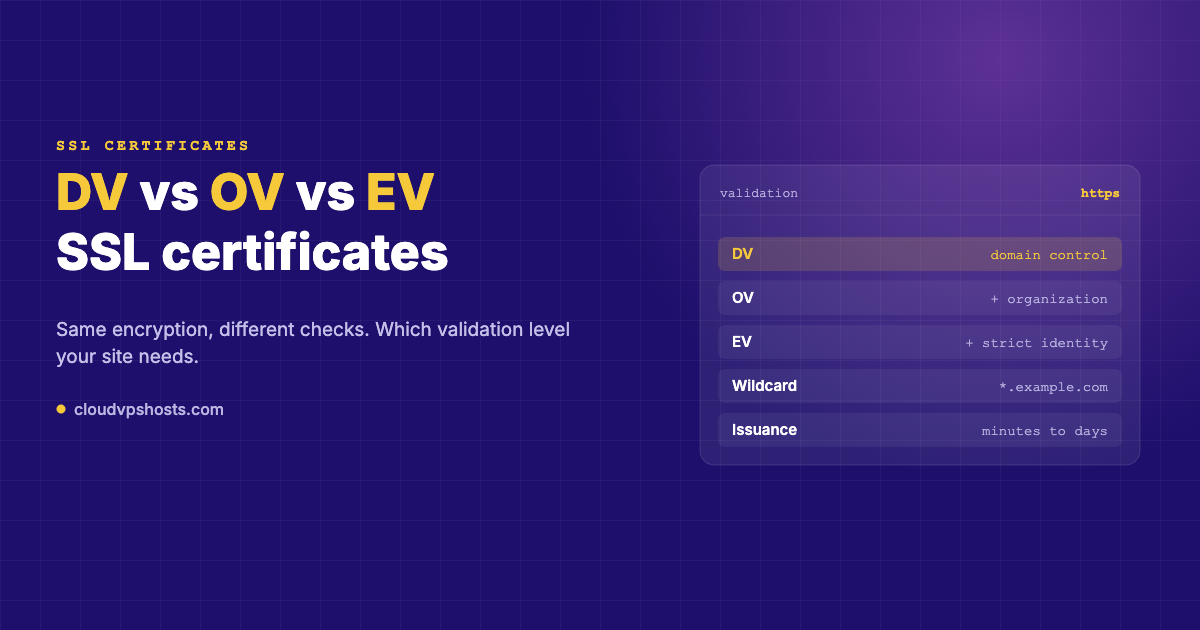
DV, OV and EV SSL certificates all encrypt traffic in exactly the same way. The difference is how much the certificate authority checks before issuing. DV confirms you control the domain, OV also verifies your organization, and EV adds a stricter identity check. For most blogs, shops and SaaS apps, DV is enough. OV and EV make sense when visitors or partners need to confirm who runs the site.
This guide explains what each level checks, how long issuance takes, where Wildcard and free certificates fit, and how the shorter certificate lifetimes that started in 2026 affect your choice.
What is the difference between DV, OV and EV?
| DV (Domain Validated) | OV (Organization Validated) | EV (Extended Validation) | |
|---|---|---|---|
| What the CA checks | That you control the domain | Domain control plus the organization’s legal existence and address | Everything in OV plus stricter checks on registration, operating existence and the person ordering |
| Name shown in certificate details | Domain only | Domain and organization name | Domain, organization name, registration number and jurisdiction |
| Typical issuance time | Minutes | Usually 1 to 3 business days | Usually 1 to 5 business days |
| Paperwork | None | Business registration details, sometimes a phone check | Business registration, verified phone, signed approval |
| Encryption strength | Same | Same | Same |
| Who can order | Anyone | Registered organizations | Registered organizations |
Is a DV certificate secure enough?
Yes, for encryption. A DV certificate uses the same TLS protocols and key sizes as an EV certificate, and browsers show the same padlock. What DV does not do is tell a visitor which company runs the site. A phishing site can get a DV certificate for its own look-alike domain just as easily as you can for yours.
DV is the right choice for personal sites, blogs, portfolios, internal tools, APIs, staging servers and most small online stores that rely on a known payment gateway for card processing.
When should you choose OV?
Choose OV when your organization’s identity matters to the people using the site, and when you sign up partners or customers who may inspect the certificate. Common cases:
- Business websites that collect personal data through login or sign-up forms.
- B2B portals and APIs used by companies that check certificate details during security reviews.
- Companies that must show verified identity for procurement, compliance or vendor questionnaires.
OV verification checks public business registers. Make sure the legal name and address you enter in your CSR match those records exactly, or the order will stall.
Is EV still worth it in 2026?
EV used to give a green address bar with the company name. Chrome and Firefox removed that display in 2019, so today visitors only see the organization name if they click the padlock and open the certificate details. EV still has value for banks, payment providers, government services and large brands that are frequent phishing targets, and for organizations whose policies or auditors require it. For everyone else, OV gives most of the same identity assurance with less paperwork.
What about Wildcard and multi-domain certificates?
Validation level and coverage are separate choices.
- Single-domain certificates protect one name. Most also cover the www version, so
example.comandwww.example.comboth work. - Wildcard certificates protect a domain and all its first-level subdomains, such as
shop.example.com,app.example.comandmail.example.com. They are available as DV or OV, not EV. - Multi-domain (SAN) certificates protect several different domains, such as
example.comandexample.net, on one certificate.
If you run more than three or four subdomains on your servers, a Wildcard is usually cheaper and easier to manage than separate certificates.
Free certificate or paid certificate?
Free DV certificates from Let’s Encrypt are trusted by every major browser and are a good fit for many sites, especially if your server can renew them automatically. Paid certificates make sense when you need one of these:
- OV or EV validation. Let’s Encrypt only issues DV certificates.
- Longer lifetimes. Let’s Encrypt certificates last 90 days today, and Let’s Encrypt has announced shorter lifetimes from 2027. Paid public certificates can currently last up to 200 days, so you replace them less often.
- Systems where automation is hard, such as Windows servers with IIS, appliances, mail servers or control panels without ACME support.
- A warranty and human support from the certificate authority if something goes wrong.
How the 2026 validity changes affect you
The CA/Browser Forum, the group of browser makers and certificate authorities that sets the rules, passed ballot SC-081v3 in 2025. It shortens the maximum life of every public SSL certificate in steps:
| Certificate issued from | Maximum validity |
|---|---|
| March 15, 2026 | 200 days |
| March 15, 2027 | 100 days |
| March 15, 2029 | 47 days |
This applies to DV, OV and EV alike, free and paid. You can still buy a certificate for one or more years. The certificate authority then reissues it for free whenever it reaches the maximum lifetime, and you install the new file. Plan for this now: keep your private key and server access details somewhere safe, and set a reminder a few weeks before each expiry date.
RapidSSL, GeoTrust or DigiCert: does the brand matter?
All three are run by DigiCert and chain up to DigiCert roots, so browser trust is the same. The differences are validation levels and extras. RapidSSL focuses on low-cost DV and Wildcard certificates. GeoTrust offers DV, OV and EV at mid-range prices. DigiCert’s own brand adds the highest warranties and priority support. You can compare them side by side in our SSL certificate store.
A quick way to decide
- Personal site, blog, test server or API: DV.
- Many subdomains on one domain: DV Wildcard (or OV Wildcard for a business).
- Business site with logins, customer data or B2B customers: OV.
- Bank, payment service, or a policy that requires it: EV.
What to do after you choose
Every certificate starts with a CSR generated on your server. Follow how to generate a CSR, complete validation, then install the certificate on Nginx, Apache or IIS. DV validation checks DNS or a file on your site, so point your domain to the server first.
Domains, SSL and VPN in one account
- Compare SSL certificates: RapidSSL, GeoTrust and DigiCert at every validation level, Wildcard included.
- No domain yet? Search for a domain and register it, or transfer one you already own. A certificate can only be issued for a domain you control.
- NordVPN protects your own connection when you log in to admin panels from hotels or cafés. An SSL certificate protects your visitors; a VPN protects you.
Frequently asked questions
Does the validation level affect Google rankings?
Google uses HTTPS as a light ranking signal, but it does not rank OV or EV sites above DV sites. Any valid certificate counts.
Can I upgrade from DV to OV later?
Not on the same certificate. You order a new OV certificate, complete organization validation and install it in place of the DV one. Your server setup stays the same.
Can an individual get an OV or EV certificate?
No. OV and EV verify a registered organization. Individuals and unregistered projects can use DV.
Why does my DV certificate need validating again at renewal?
Since March 2026, certificate authorities can reuse a domain check for at most 200 days, falling to 10 days by 2029. Expect to confirm domain control by email, DNS record or file more often than before.
Do I need a separate certificate for my mail server?
Not if the mail host name, such as mail.example.com, is covered by your Wildcard or listed on a multi-domain certificate. Otherwise you need a certificate that includes that name.